
The assistant that already knows your business
If you've been using ChatGPT to think through your business — the name, what you offer, who it's for, the tone you want, the prices, the plans — it already holds the most important ingredient of your website: the context. Every website builder makes you type all of that in again. With Ullbek installed, you don't.
You stay in the chat you already use. Ullbek supplies the workshop underneath: sites, live previews, publishing, contact forms, hosting, and your own domain. ChatGPT does the building, drawing on everything you've told it. The result is a real, custom website built around your business — not a template with your logo dropped in.
Same account, two doorsEverything ChatGPT builds lands in your normal Ullbek account. Open app.ullbek.com anytime and continue in the Ullbek builder — same sites, same files, no import step. Switch back and forth as much as you like.
Install the Ullbek plugin in ChatGPT
You'll do this once. It takes about a minute, and there is nothing to pay Ullbek for — installing is free, and your ChatGPT plan powers the conversation.
- Open Plugins in ChatGPT
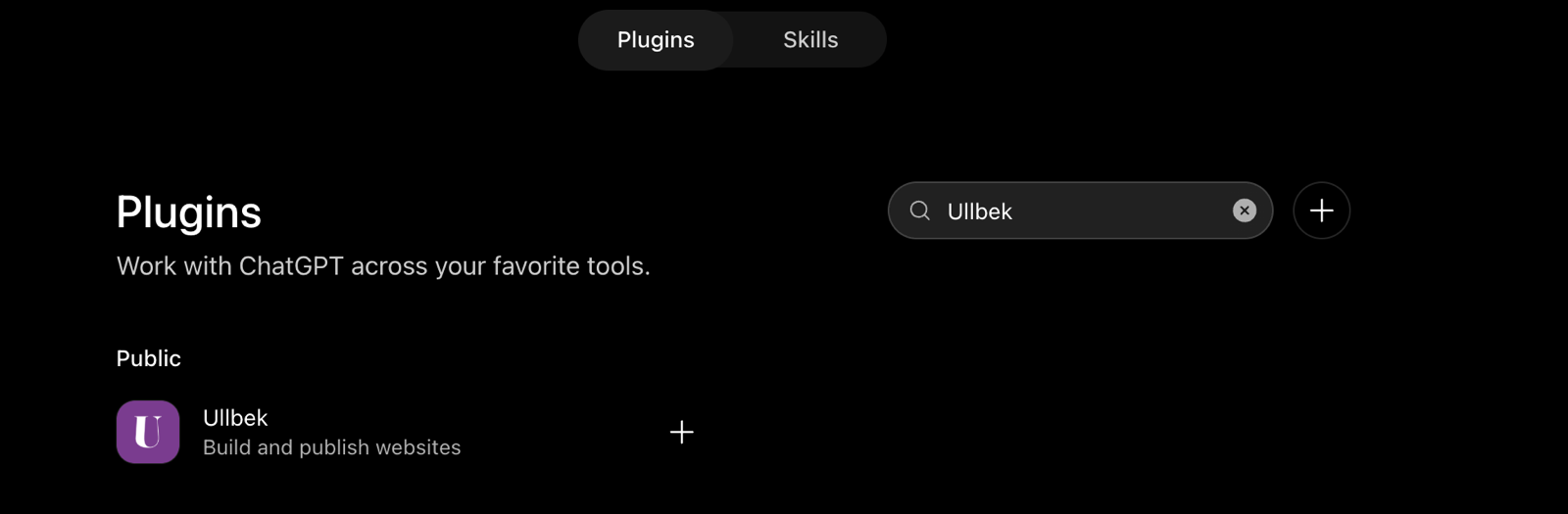
In ChatGPT on the web or in the desktop app, click Plugins in the left sidebar (the grid icon), or go straight to chatgpt.com/plugins. Search for Ullbek.
- Install it
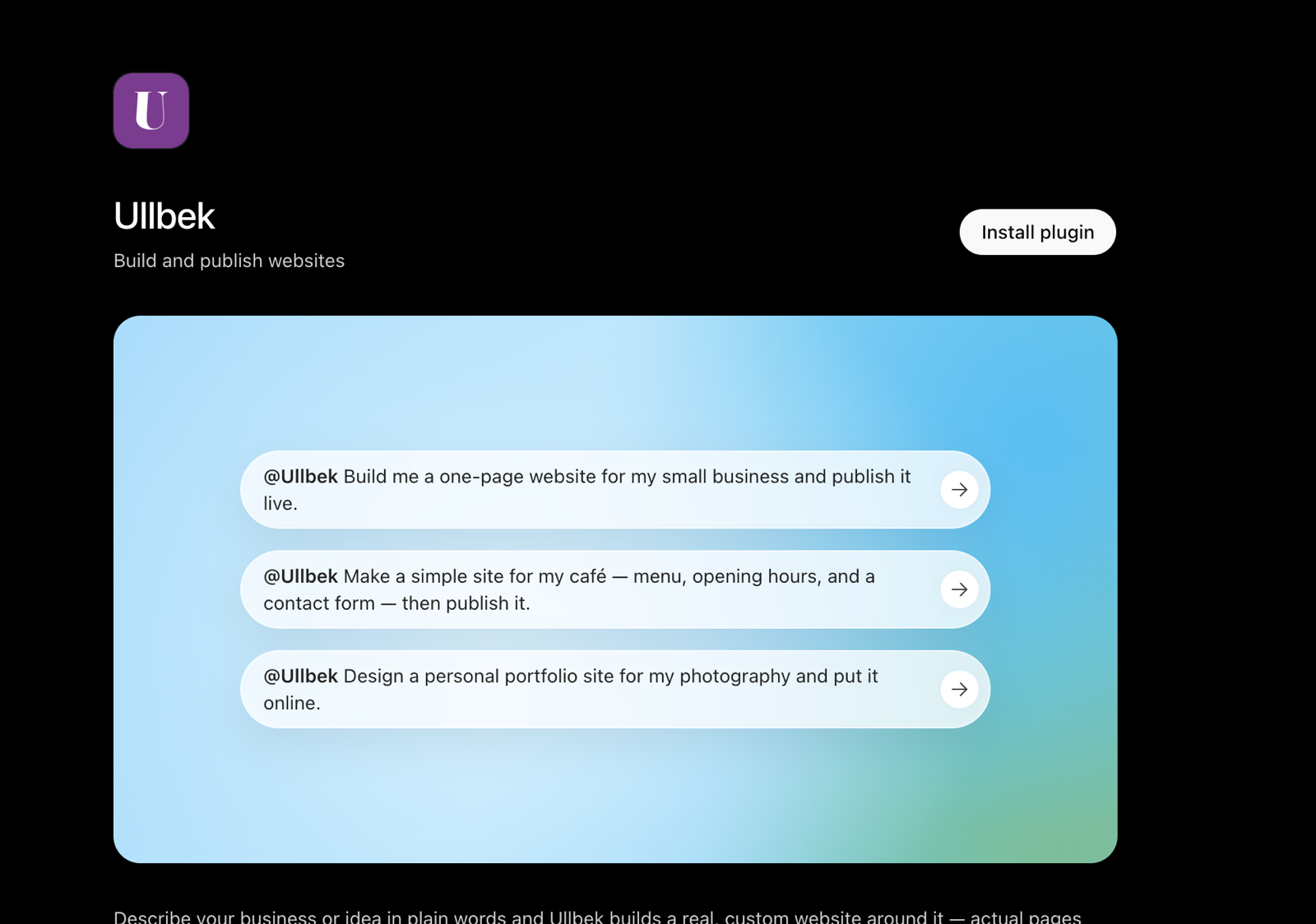
Open the Ullbek listing and click Install plugin. Here's the direct link if you prefer: Ullbek in ChatGPT.
- Sign in and allow
ChatGPT opens the Ullbek sign-in page in your browser. Continue with Google or sign in with email — or create your free account right there if you're new. Review what the connection can do, then allow it. Back in ChatGPT, Ullbek is ready.
Menu names move aroundChatGPT has called this area Apps, Connectors, and now Plugins, and it may again. The constant is the search: wherever ChatGPT lets you add apps, search for Ullbek and install it.
Build your first site
Start a new chat, type @Ullbek to bring it in, and describe what you want. The more you've already discussed with ChatGPT, the less you need to say now — just point it at what it knows.
ChatGPT then works for a few minutes: it creates the site, writes the pages, sources images, checks its own work, and hands you two links — a private preview of the real site, and, when you say the word, the live address.
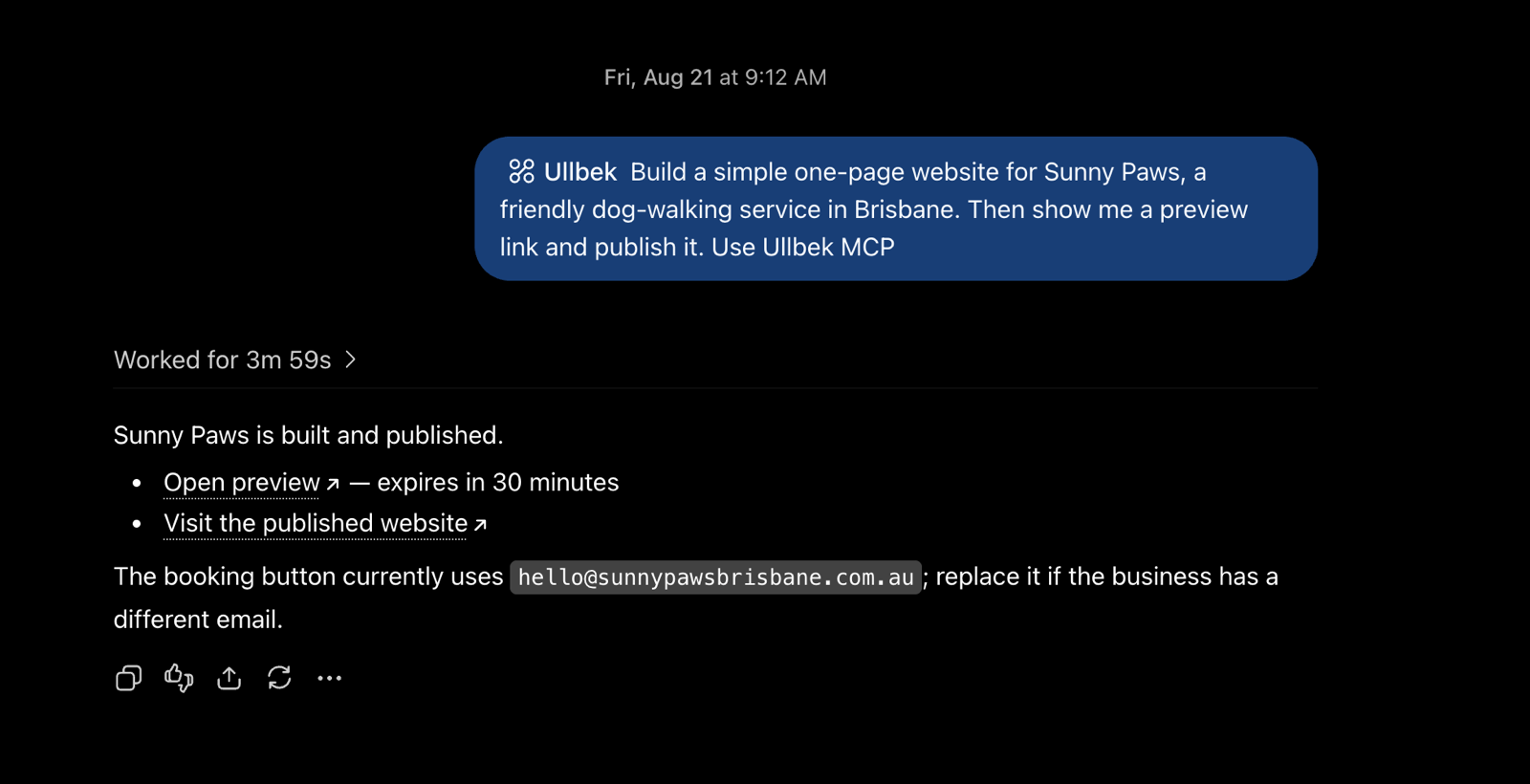
From there it's a conversation. "Make the header warmer." "Add a section with the opening hours." "Use the photo I uploaded for the hero." Every change shows up in the preview; publish again whenever you're happy. Every site gets a free yourname.ullbek.site address with hosting and HTTPS included.
Getting the most out of it
Lean on what ChatGPT already knows
Say "use what we discussed about my business" or "based on the plan we made last week." ChatGPT can carry your earlier conversations and memories into the build, so the site reflects the real business — its offer, its voice, its customers — instead of a generic first draft.
Ask for a preview before publishing
The preview link is the real site, served exactly as it will go live. Open it on your phone and your laptop, click through every page, and send changes back in plain words. Publish only when it looks right.
Ask for a screenshot
"Show me a screenshot of the homepage on a phone" gets you a picture right in the chat — handy for a quick look without opening a link.
Continue in the Ullbek builder when you want the full workshop
Side-by-side live preview, the brand kit, your assets, form submissions, models to choose from: all of it is waiting at app.ullbek.com, on the same site ChatGPT just made. Many people start a site in ChatGPT and polish it in the builder.
What ChatGPT can do with Ullbek
Once installed, ChatGPT gets the same abilities the Ullbek builder has — the full journey, not a demo:
Create & edit sites
Start a new site or keep improving an existing one — pages, sections, images, colors, the lot.
Live preview links
Ask for a preview and you get a private link to the real, running site — click it and see exactly what will go live.
Publish & go live
Free address included, secure HTTPS and all. Say the word and your site is on the internet.
Your own domain
On premium hosting, connect a domain you own — ChatGPT walks you through the setup, record by record, and confirms when it's live.
Read your messages
"Any new messages from my contact form?" — form submissions arrive in your inbox and ChatGPT can read them back to you.
Images & screenshots
Stock photos, generated art, and fresh screenshots of your site, right in the conversation.
Premium hosting and your own domain
The free address is yours for as long as you like. When you want the site on your own domain, premium hosting is set up on your Ullbek dashboard — open the site there, choose premium hosting, and connect or buy your domain. Once the site is on premium hosting, ChatGPT can take over the technical part: it tells you exactly which DNS records to add and keeps checking until your domain answers.
Payments never happen in chatChatGPT can never charge you. Anything paid — premium hosting, a domain, extra credits — only ever happens through a secure checkout page that you open in your browser, from your Ullbek dashboard.
Claude and other assistants
Ullbek works with any assistant that supports connectors — the open standard is called MCP (Model Context Protocol). ChatGPT gets the one-click install above; everywhere else, this is everything the assistant needs:
- Claude on the web or desktop
Go to Settings → Connectors → Add custom connector, paste the URL, and follow the same sign-in-and-allow flow.
- Claude Code (for the technically inclined)
One command in your terminal:
claude mcp add --transport http ullbek https://api.ullbek.com/mcp— then authenticate when prompted. - ChatGPT, without the directory
If you'd rather not use the directory listing, ChatGPT's developer mode accepts the same URL as a custom connector. The abilities are identical.
Some tools — desktop apps and power-user settings screens especially — show a fuller form instead of a single URL field. It usually looks something like this, and only three fields matter:
Connect to a custom MCP
If your tool asks for a connection type, pick Streamable HTTP (Ullbek is a remote server, not a program on your computer — that's what STDIO is for). Name it anything you like, paste the URL, and skip every token and header field: the sign-in happens in your browser when you first use it.
Good to know
Is this safe?
The connection can build and publish websites on your account — and that's it. It cannot spend your money (payments only complete in a checkout you open yourself), and sites published from a chat pass the same content review as sites published from the builder. Sensible per-account rate limits apply.
How do I disconnect?
In ChatGPT, open Plugins, find Ullbek, and remove it — the same place you installed it. That ends its access; you can reinstall anytime with the same steps. Your sites stay safe in your Ullbek account either way.
Which is better — ChatGPT or the Ullbek builder?
They're the same account, so it's never either/or. The Ullbek builder gives you the full workshop: side-by-side live preview, brand kit, assets, models to choose from. ChatGPT gives you convenience and context — the assistant that already knows your business can act on it. Many people start a site in a conversation and polish it in the builder.
Your website is one message away
Install Ullbek in ChatGPT, say what you want, and the business you've been talking about becomes a real website.